Sunday, October 22, 2006

Shakti and Web 2.0?


The fullness of strength is Shakti
Shakti is bliss brimming over
Shakti is the glowing fire of love
Shakti is intuition that enriches life
The light that lights the heart is Shakti

Traditional Tamil peom: Shakti (Divine Female Energy)

OK so you wont be surprised to hear I went to the Art Gallery of NSW Exhibition - Goddess Divine Energy.

On Thursday 19 October and Friday 20 October I listened to Nancy White and George Siemens at Elearning 06 at Randwick Racecourse. The two days were also spent networking with generous, gregarious, talented and creative people.

I have a lot of rich impressions and interconnections that are spilling over from this input that I would like to give some form to here. This is my chance at what Nancy White put forward in her keynote presentation as participation and reification. Reification is recreating or redeveloping your learning in another form.

The theme that stood out for me from Nancy's presentation was "Together in Time and Space", Nancy brought to it the feminine power of Shakti. I can't name all the female participants that displayed qualities of Shakti over the two days, it would be every female, and some of the males I came into contact with.

George Siemens spoke in depth about many things that hit home with me and more than once I was nodding, feeling he was speaking directly to me. But as I am working from memory rather than notes what I remember was the slide of a learning ecology and the link between a thriving learning ecology and a robust network. I liked the colourful learning ecology slide of weird shapes and organisms.It was the most vivid and evocative slide I have ever seen at a conference.

He made it clear that our partiality to the system we have trained in is understandable - but also made it clear that co-creation and networking of knowlege have changed the world as we know it forever. I would have liked to talk to him more, his ideas are hot!

More on the theme of Goddess Divine Energy in Connected Learning coming soon!

Thursday, October 12, 2006

1, 2, 3 - Create, Upload, Distribute!

I have just caught up with how easy and effective it is to create, upload and distribute media using an N91 phone, a blip tv account, and a multimedia player, or phone.

Shoot it on the phone, upload from phone straight into the blip tv account, push it out via rss feed to automatically download to multimedia player or phone.

Stephen Parker put this technology to great use on the recent FLNW tour, although he used a webcam rather than phone to create the video.

I learnt this because Alex Hayes showed me how - here is a short piece we made as a scenario discussion starter for use with primary school kids to show Graham Wegner over at Teaching Generation Z last night. Probably took half an hour to shoot, load and send to Graham.


Not just a phone!


It's amazing how many things are inside a phone ! Things for you to think about for mobile learning IN the classroom.

Tuesday, October 10, 2006

Getting CLC savvy


I am a participant of the NSW Connected Learning Community Learnscope (CLC) team. I am committed to the concept underpinning the project - to develop knowledge and learning through connection and conversation using Web 2.0 and social software.

I have only just begun to realise how ambitious this project is in its intention for individuals of varying skill level and committment to 1. embrace the concept
2. develop fully operational personal learning environments 3. commit to engaging in the dialogue of the community - all in a time frame of 3 or 4 months.


Embracing the concept is easy, as educators using Web 2.0 tools and applying constructivist and connectivist theories to enhance accessible and flexible learning, we love it!

Developing the fully operational personal learning environment, not so easy.

It has taken me longer than I thought to get to (not highly enough prioritised?) and longer than I thought to learn how to tweak the template and create the connections. Half my problem is forgetting my password for bloglines to share my blogroll, and there is always Second Life to explore - have had much more fun getting Jo Kay and Sean Fitzgerald to show me great places to buy great clothes and hair for my avatar!


Commiting to engaging in the dialogue of the community, well I think that will come as the community gains momentum. From what I can see, members of the community are at different stages - some are blogging, some are not, some are connected, some (me) are not.

With the benefit of hindsite it is my opinion that this project potentially has two phases - the first would be getting ready for the CLC, - and the second would be the CLC in action.


Words like evolving and coalescing lodge in my mind when thinking about the CLC. If you peer closely individual members are evolving at different rates, standing back and looking at the community as a whole it is easier to see how the group is transposing.

The spirit of the CLC was ignited by Sean Fitzgerald, as a community all we have to do now is put our weight behind its gathering momentum.

Friday, October 06, 2006

Taking Risks to Learn in the Network


Postcard of me/my avatar, AnnaB Paterson, on a horse in SecondLife.

At the moment my avatar is running around in Second Life without hair and sometimes I cant make her stop dancing. Sometimes I manage to detach all her clothes leaving her naked in public places, something respectable educators should never do! Am I embarrassed at branding myself as such a newbie, you bet I am, but I do it anyway.

I am finding myself with either thicker skin or more willingness to take risks in participating in the Network. It is a risk because I am forever exposing what I don’t know in order to develop my learning – I feel I am developing the attribute of being less self conscious in going about my learning. When all my clothes fall of I am uncomfortable, but I am still in the network and I am still learning.
My own take on groups and networks

I have been talking to Leonard Low over at Mobile Learning about having a go by participating and contributing to learn. Then the same thing came up for me over at Stephen Downes blog
in differentiating between networks and groups. I have included my comments here because I am proud of them, and also because I want them to be picked up and discussed by the Connected Learning Community as part of a Learnscope project I am participating in.

I think that although reason prevails in a network, the networks are made of individuals, those individuals are emotive, the individuals in the network become empassioned. The network doesnt necessarily have the drawbacks of the "Group at any risk" concept so well explained by Stephen , but it has advantages in momentum to gain if enthused with passion and some common understandings like tolerance, being unselfconcious and taking risks in teaching and learning. I dont think common understandings make you a group, but I do think passion and emotion can sit next to reason.

I think the personal experience, speaking in a personal voice and passion and not being selfconcious are the attributes needed to teach and learn today. Sparker I see the emotive voice as a turn on in learning and seeing the world, not a turn off. The emotions are important in interpreting the ideas.

Those speakers on the recent FLNW tour were a network
of passionate individuals who have expanded the wingspan of Networked learning ideas in their practice. They were definitely unselfconscious – so much media, there were over 1000 photos alone let alone podcasts , videos and network members blog entries, and group emails.

The broad networking capability of social software has impacted on how we talk to each other. It means that I can reflect and participate here, right on Stephens blog. I am demonstrating an unselfconciousness in revealing what I think and know or not know. I am motivated to participate and therefore learn. If I thought I had to impart pearls of wisdom everytime I am motivated to participate and learn, I am sure I would not participate.

Tuesday, October 03, 2006

Using Mobile and Wireless Web 2.0 to meet VTE learners needs.

A discussion over lunch delivered one of those moments where you go "why didn't I think of that?".

A friend that works for a large industry organisation explained a simple but efficient use of SMS in training. When new material goes up on the organisations intranet, training participants are sent and SMS to direct them to it.

Simple and elegant, where I have been nagging teachers across the State to subscribe to the site so they would be notified of updates, this organisation simply used SMS broadcast via group email and delivered the message to their pockets. They follow up by analysing the hits on the site using traffic monitoring software, so another SMS can be sent as reminders to people who had not yet accessed the site.

Tomorrow I will start chasing up mobile phone nos........

Monday, October 02, 2006

Post-modern Models of Learning

I will try and paint a verbal picture of what I think post modern learning models look like. I am thinking about the learning models as complex shapes and permutations. There are subtle nuances of colour and pattern within the myriad of complex shapes.

The combinations of shapes, colours and patterns represent the models of learning that are possible and make it feasible to create a custom fit to the needs of your learners.

Some of the things that come up when custom fitting learner needs are:
- Flexibility in timing, delivery mode/s learning styles, conversation style, assessment methods and strategies, support
- Context and content of the course or qualification
- Learner profiles, individual needs and preferences

Here is a couple of technology assisted learning models out of a possible zillion I suspect:

Model 1 - Uses mobile phone and SMS based Study Txt model, supported by del.ici.ous tags housing resources, video blogs capture evidence of achivement. Follow the link from Study Txt model to see a video of Peter Mellow giving a demonstration of how Study Txt works.

Model 2 - A Personal Learning Environment - Sean Fitzgeral explains the concept and practice very well here.

Model 3 - Using a group blog or wiki to collaborate and grow learning materials, videos on YouTube and photos on Flickr with common tags used by the group, RSS feeds - posted on blog or wiki.
In Knowlege Sharing with Distributed Network Tools Leigh Blackall and Sean FitzGerald demonstrate some of the online tools that can be used to share knowledge - social software, web feeds, tagging and Creative Commons licensing - and discuss how they are part of the emerging networked learning paradigm

Each of these models are achievable and accessible using a Personal Digital Assistant or Smartphone.

So, I have had a go, from my own available experience. You have other experiences and would come up with other models. Have a go, I want to talk to you about them.

This is where my spruiking about being an unexpert becomes concrete. The reason for not bowing to experts, or waiting to become one is that your learners have needs that need meeting now.

In the many presentations about Using Mobile Phones and Wireless Technology in Learning I rsisted articulating made up solutions to made up problems. What was really important was to hold a space for the participants to use their own expertise of the learners needs. Providing them with enough information to start them off maybe gain some inspiration from myself as a non techie unexpert.

We have new tools to add to our master craftmens and craftwomens collection of tools that we use in the conversation with learners, and my view from over twenty years in Vocational Training and Education is that there are plenty of master craftmen/women out there who are more than ready and willing to participate and contribute to a 21st century learning conversation with other learners.
Personal Adjustment for Learning in the 21st Century
Just Have a Go!

In my last post I mentioned the personal adustment needed to participate in the development of a collective expertise, a bit like seeing ourselves as part of a pervasive universal energy grid instead of being individual bright sparks only capable of ingiting small shrub fires. I urge you to take your place in the grid!

I also talked about being an "unexpert" - and now I am going to put myself forward and out there as an unexpert and take my place and participate in the learning conversation. I want to talk about what I think post modernism is in the context of learning.

Can you see the model, the personal adjustment I am demonstrating here? I haven't read widely, or debated post-modernism at any length with anyone. I can't tell you who has come up with the defining ideas on the topic - but I have my own ideas that I want to put forward, whether they be too simple or not well informed and I will probably not look very clever - but people with more info about postmodernism and learning will expand my knowledge, point me in the right direction. Maybe other people will talk about how the ideas relate to them, or raise their own ideas.

One thing is sure and that is that collective expertise will always have greater depth and breadth than individual expertise (I guess it would have been enough to say that three heads are better than one!).

I will have a go and reap or regret the consequences. The personal adjustment I need to make to further my learning is to just to have a go and have the conversation. No pointing and laughing please!

Now because like most learners I have lots of stuff going on in my life I will have to leave my ideas about post modernism in learning to the next post. The scene has been set and we will keep talking.

I would love to connect to you via this blog by linking our blogs together via the blogroll, although as I write there is no blogroll on this blog at the moment. Post me a comment with a link to your blog and we will converse that way! We can have a go together!
Participation + Contribution = Learning
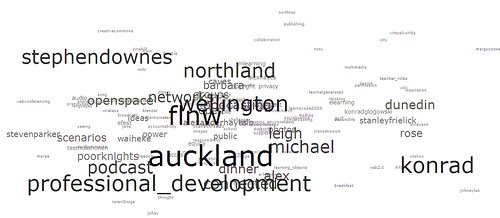
Leigh Blackall: FLNW tag cloud
link to the tag cloud


I have been inspired by the recent tour of the openspace conference Future of Learning in a Networked World (FLNW). Leigh Blackall's message Teaching is dead has been heralded through a number of locations in New Zealand in the second half of September. I feel like I was there, without having to get so tired. You can feel like you were there too by going to the wiki and following the links to participants blogs, flickr photos (971 at last count!), podcasts and videos!

We all know about behaviourism, constructivism, and some of us are out there (un?)evangelising connectivism. Educational theories aside I think the new paradigm emerging in all sorts of learning contexts today requires a personal adjustment in our approach to learning.

The FLNW pioneered Leighs vision of the "unconference" of learning as a conversation. The personal adjustment that I think needs to take place is about adapting to a new scenario of professional development(PD) that is self organised and self directed. Letting go of the idea that PD means sitting in a room with 20 others at a session you have no stake in. It is about seeing ourselves, and the people who are usually at the front of the room equally as "unexperts".

I am always offended by the term "expert". People develop expertise when they spend a long time doing something,focusing, reflecting, developing, sharing, networking and growing knowledge. We don't need to bow to expertise, we each have our own personal expertise that is just as important in a professional development setting. It really comes down to valuing our own
experiences and the experiences of others and using that fertile bed to grow new knowledge. There are subtleties of each of our experiences that the experts don't have, and we do not have theirs. So lets look at all of us as "unexperts" and equal. Teaching is dead. Thank you Leigh.

Participation + Contribution = Learning